Scaling Solar on a Massive Commercial Roof: The Wright-Way
Updated: Jul 30
How Smart Engineering Delivered Far More for the Same Budget
Commercial solar is a completely different game from residential. The loads are enormous, the roofs are huge, and the financial math only works when every dollar is stretched as far as it can go. The Komatsu project is one of the clearest examples we’ve had of turning a rigid customer specification and a fixed budget into something significantly better.

The client came to us with a fully defined wish list: a specific panel, a specific microinverter, a specific tilt racking system, and a clear directive — get as much of that exact system as possible for a set budget. Most contractors would have simply run the numbers on the requested equipment and stopped there. We did that bid… and then we did something extra.
We also showed them what the same money could buy if we applied our own engineering approach, equipment knowledge, and real-world experience. They liked what they saw.

Phase 1 – During Construction
We installed the first large section of the array while the building was still under construction. That portion alone was already substantial.
Phase 2 – The Expansion
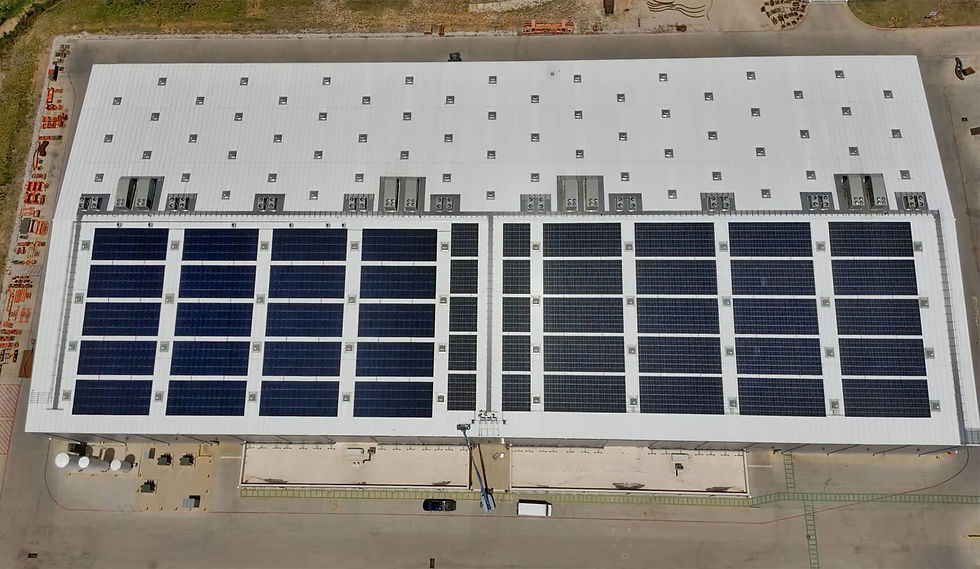
After the building was complete, we were able to come back under the industrial permit exemption and add a second, even larger section of solar. The expansion pushed the total array well beyond the original scope — significantly more coverage than the client’s original equipment list would have allowed on the same budget. We achieved this by switching to a more competitive high-quality panel and by strategically omitting rapid-shutdown devices that were not required for this particular large-scale commercial design.
All of the inverters live on the roof. Each major grouping has its own DC disconnect/kill switch for safety and serviceability. When you see the finished array from the ground or from a drone, the scale is hard to grasp until you notice a technician looking tiny against the sea of panels. It is one of the largest single-roof commercial arrays we have completed and amongst the largest in the state.
The Real-World Result
Even with this massive system, the solar only offsets about two percent of the facility’s total energy consumption. That sounds small until you understand the context: the building’s heating and cooling loads are enormous. What the solar array actually did was prevent the power bill from climbing higher as those HVAC loads came online. In commercial and industrial settings, “keeping the bill from going up” is often a bigger win than trying to zero it out.
This project is a perfect illustration of why experienced commercial solar contractors matter. Off-the-shelf equipment lists and rigid specs rarely deliver the best value. Knowing which components can be optimized, how permitting pathways work, and where real performance (and real savings) actually come from is what turns a good project into a great one.
Why This Matters for East Texas Commercial Property Owners
If you have a large roof, a warehouse, a manufacturing facility, or any high-load commercial building, the difference between a standard bid and a properly engineered solution can be thousands of kilowatt hours and years of better cash flow. We know how to work inside real-world budgets and still deliver more production than the original plan called for.
Ready to see what your commercial roof can actually do? Contact Wright-Way Solar. We’ll show you the standard bid — and then we’ll show you the smarter one.


